EchoBridge
Local-first meeting recording and transcription with voiceprint speaker identification. Your meetings, your hardware.
Status: I'm planning to open-source it in December 2026.
Why I built it
I needed to track recurring meetings without sending sensitive conversations to someone else's cloud. So EchoBridge runs locally: fine-tuned models on the device, or on a server you control, with no third party in the loop.
What it does
- Calendar-driven recording: pick Google Calendar events to record automatically.
- Speaker identification: voiceprints recognize speakers across meetings and build a participation history.
- Prompt builder: ask across meetings, e.g. “summarize progress and next steps from the last 3 weekly meetings”.
- Team sharing: share recordings and transcripts securely.
- Offline-first: works fully offline on a custom local-first engine.
- Self-hosting: deploy with Docker on your own server, with swappable models for transcription, diarization and embeddings.
EchoBridge Calendar Integration Demo
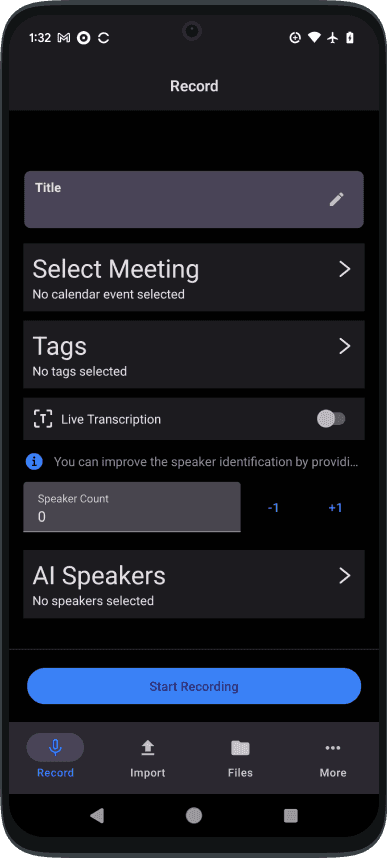
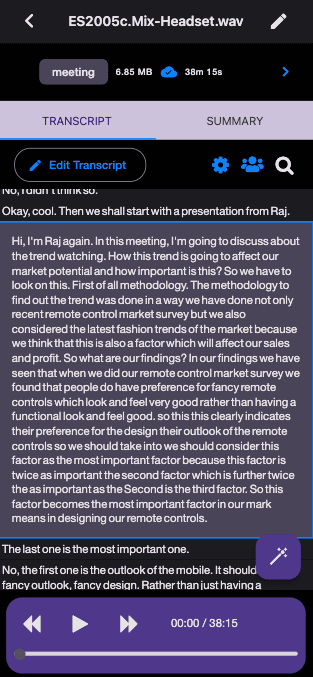
EchoBridge mobile app and transcript view
How it's built
- React Native + Expo (mobile and web), TypeScript.
- Recording and audio on Audiolab (@siteed/audio-studio).
- Custom local-first sync engine built from scratch.
- On-device fine-tuned models; GPU acceleration when available.
- Docker for on-prem deployment.
- Heavier transcription, diarization and embedding jobs go to my home DGX Spark cluster; lighter services run on a home GPU workstation (see the lab).
- Models: Whisper for transcription (whisper.rn on the phone, Whisper medium on the server), pyannote speaker-diarization-community-1 for diarization, and SpeechBrain ECAPA embeddings for voiceprints.
What's open
- Already public: the recording library (Audiolab).
- Planned for December 2026: the rest of the project, with the exact scope listed here at release.
Try it
Demo: echo.siteed.net ·GitHub repo and quickstart: with the open-source release.